Digital Market Act: What Impact for Retail Chains?
Discover the Digital Market Act (DMA): new challenge for online referencing for retail networks! In this article, we explore the concrete impact of the DMA on the online referencing of retail network points of sale. Discover solutions to optimize your presence in this new regulatory environment and stay close to your customers through good online visibility.
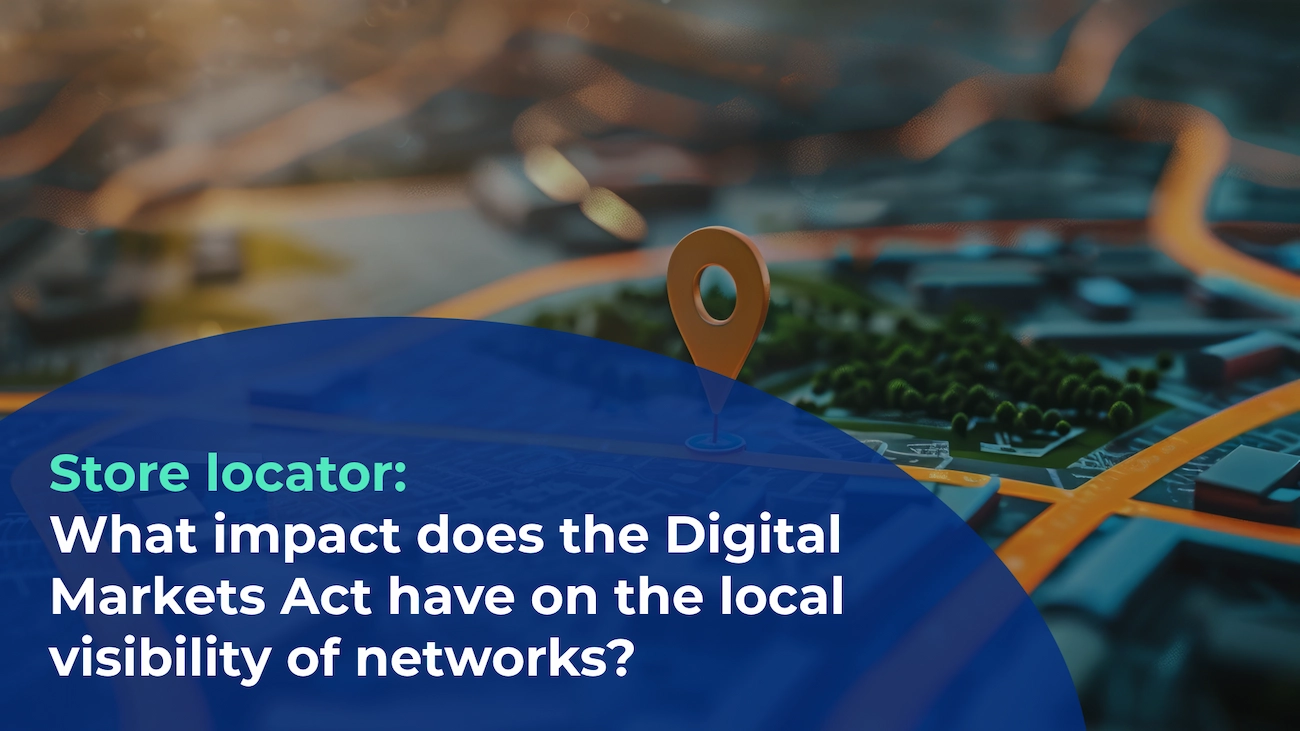
- Digital Market Act Revolution: what impact for your network of points of sale?
- How to optimize the visibility of your local points of sale under the Digital Market Act?
- Conclusion
The Digital Market Act (DMA) law adopted by the European Parliament, came into force on May 2, 2023. Its implementation will effective from March 2024, marking undeniably a major turning point in the European digital landscape
Its goal is clear: regulate the web giants (GAMAF - Google, Apple, Microsoft, Amazon and Facebook) to reestablish a more equitable balance of power within the online platforms market.
This new regulation will have significant consequences for smaller players and will open up new opportunities for their influence in search results.
If this development will impact all businesses, it will play a crucial role for brands with retail networks, multi-store or franchise networks, by redefining their online visibility and search engine ranking.
Digital Market Act Revolution: what impact for your network of points of sale?
With the DMA coming into force, your retail network is about to face a digital revolution. This regulation aims to put an end to anti‑competitive practices by suppliers, notably by prohibiting favours granted to their own products and services. In case of non‑compliance with this rule, fines of up to 10% of global turnover, or 20% in case of repeat offences, may be imposed by Europe.
Mais ce n'est pas tout, Google, en tant que géant du web, devra également se conformer au DMA. Les pages Google fiches d’établissement (Google Business Profile, anciennement Google Business Profile) devront être sur un site dédié avec une page spécifique pour chaque établissement, similaire à un annuaire indexé. Cette mesure entraînera une réduction de la visibilité de Google Business Profile (GBP), pouvant selon différentes sources, varier entre -20 à -90 %. En revanche, les sites des entreprises et les pages de Store Locator (SL) seront mis en avant, offrant ainsi une projection d'augmentation du trafic de 200 % à 800 %.
How to optimize the visibility of your local points of sale under the Digital Market Act?
With the entry into force of the DMA, optimizing the visibility of your local points of sale becomes a crucial priority for brands. From March 2024, focusing on the optimization of the Store Locator (SL) and presence in relevant global and sectoral directories will be essential to stand out in this new regulatory environment.
Here are some essential tips to ensure optimal visibility for your local points of sale:
- Store Locator :
If your brand has multiple points of sale, the Store Locator becomes an essential tool. Make sure to include all crucial information such as:- the full address with precise geolocation
- links for the route calculations via different mapping tools (Google Maps, Apple Plans, Waze, TomTom, Here WeGo)
- the phone numbers
- the regular opening hours as well as the exceptional hours clearly indicated
- the customer reviews coming from trusted partners specific to your sector.
- Data structuring on the website and the Store Locator :
Ensure that your data are correctly structured according to schema.org to appear in enriched search engine results.
More information on what structured data is and why it is crucial for your online visibility in our article:
How to appear in Google's enriched results
- Page load speed optimization :
A fast loading time is essential to provide a better user experience, both on desktop devices and on mobile. - Directories and intermediate platforms :
The DMA will significantly benefit intermediary platforms, reservation and directory platforms by allowing them to gain visibility.
To reference yourself, use the appropriate intermediary platforms according to your sector:- All types of business : PagesJaunes, Facebook Business Page,...
- Tourism: Booking, TripAdvisor
- Catering :The Fork, Restaurant Guru
- Others : Planity (Well‑being), Doctolib (Health), (Santé), LaCentrale, , Allogarage (Automobile), etc. (Automobile), etc.
By following these recommendations, you will be able to ensure a solid online presence for your local points of sale, while taking advantage of the new Digital Market Act regulations. This optimization will enable you to position yourself advantageously in search results and better meet your customers' expectations by providing them with an optimal user experience.
Conclusion
The Digital Market Act brings significant changes to your online visibility as a network of brands. To ensure you remain competitive and take advantage of new opportunities, it is essential to understand the changes brought by the DMA and adjust your strategy accordingly.
In this new regulatory context, it is crucial for you to focus on optimizing your Store Locator, your presence in relevant directories, as well as on the structuring of your data to appear in enriched search engine results.
By following these tips, you will be able to maximize your online visibility and attract a larger number of customers to your physical points of sale.
However, it is essential to note that despite the projections and discussions on the impact of the DMA, negotiations with the European Commission are still ongoing, and the final results are not yet known. It is therefore imperative that you stay informed and closely follow the evolution of the situation in order to best adapt to the new regulations and upcoming opportunities.
Sources:
"DMA: future of Google Business Profile listings" - Smart Traffik
Save time and gain visibility from today
Schedule a personalized demo and see how the platform optimizes every local action in your network.


Latest articles
Discover other selected articles to further explore the topic. To continue exploring the levers that really make a difference for your points of sale.