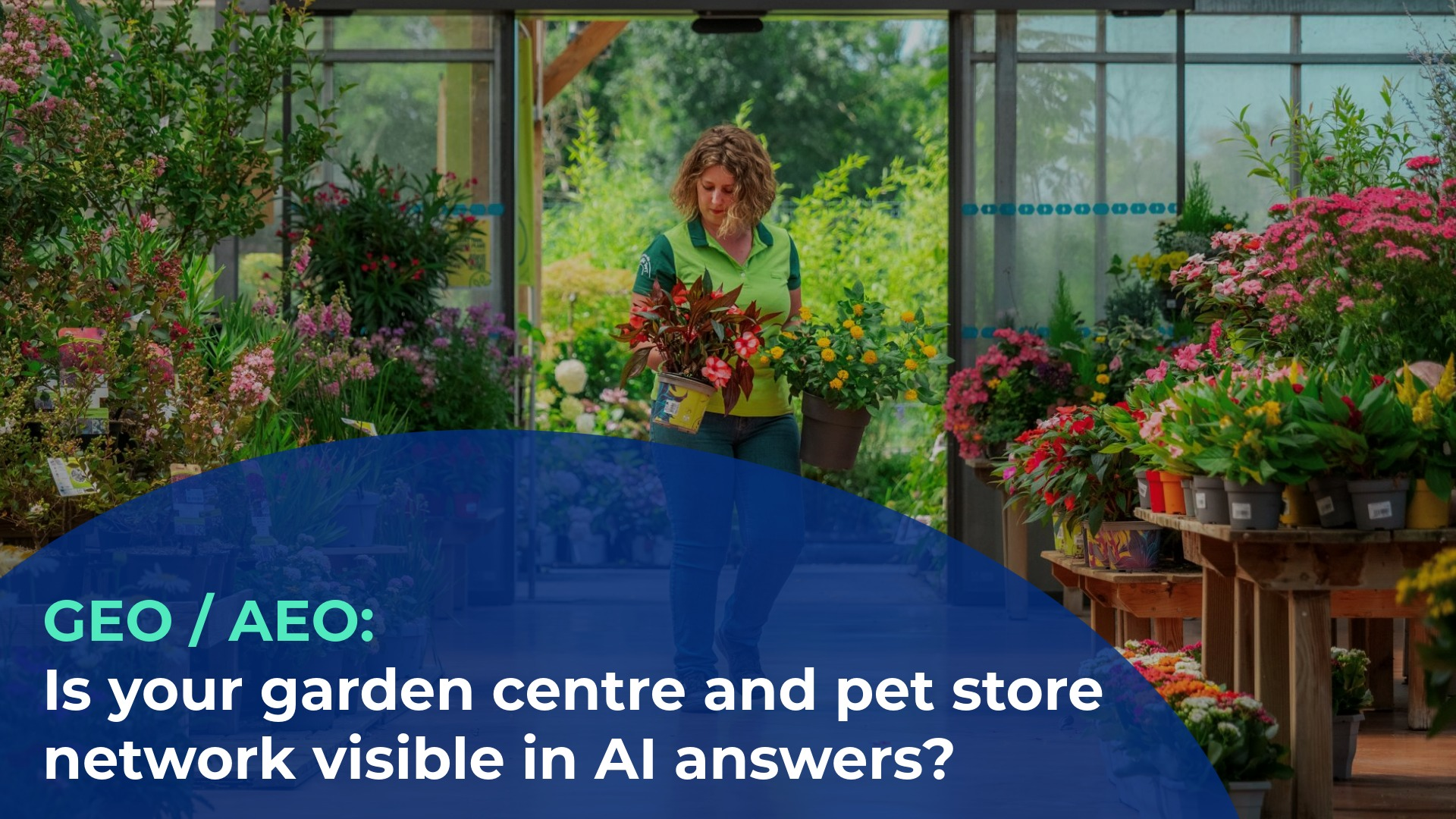
Is your network of garden centers and pet stores visible in AI answers?
ChatGPT, Perplexity, Google AI Overviews: when a customer searches for a garden center or pet store near them, the answer they get no longer comes from a list of links. It comes from the data your network exposes to them. Five tests to find out where you stand.
Key takeaways from this article
- Generative engines recommend a specific point of sale, not a list of addresses. If your local data isn't structured for them, your network doesn't exist in their answers, even if your Google listings are up to date.
- Five tests can diagnose your AI visibility in under an hour, with no technical skills required.
- Two negative answers out of five indicate a Local Data Infrastructure problem: your local data cannot be read by the machines that recommend points of sale.
Why the question arises differently for garden and pet store chains
The sector is particularly exposed to changes in search engine behavior. Queries there are naturally conversational and geolocated: "peat-free drought-resistant potting soil in Nantes," "dog grooming service available on Saturday in Ghent," "where to buy a captive ball python in Bordeaux." This type of query is exactly what ChatGPT, Perplexity, and Google AI Overviews now prioritize.
Three sector dynamics amplify the challenge.
Seasonality is brutal and localized. A heatwave creates immediate demand for drip irrigation systems and thermal protection for animals. This demand is geolocated and short-lived. A store absent from AI responses during this peak loses a flow of customers who will not come back.
Advisory queries absorb traffic before local search. "How to treat box tree moth naturally?" or "What food for a sensitive puppy?" now find a direct answer in the AI interface, with no redirection to a website. If your network is not the source cited in that answer, the customer will never look for your store.
The regulatory context pushes toward prior local verification. Between European restrictions on plant protection products, Belgian and French regional regulations on animal welfare, and restrictions on the online sale of certain species, consumers seek verified local advice before making a trip. They ask an AI this question. If your store is not in the answer, your competitor is.
5 tests to find out if your network is visible in AI answers
These five tests require neither a paid tool nor SEO expertise. Open ChatGPT or Perplexity and test on your own cities.
Test 1: Does ChatGPT know your stores correctly?
Ask the question: "Where can I buy hypoallergenic veterinary kibble near [city]?" or "Which garden center offers plants for limestone soil in [city]?". Does your brand appear? If so, are the name, address, phone number, and opening hours accurate?
LLMs compile their answers from Google Business Profile, Apple Business Connect, local directories, and the content of your store pages. An incomplete or contradictory listing does not produce a wrong answer. It produces an absence.
Test 2: Are the opening hours the same across all platforms?
Check for the same store: Google Business Profile, Apple Maps, Waze, Facebook. Are the displayed hours identical? For a garden center chain, summer hours, holiday closures, and spring Sunday openings vary from one store to another and from one season to another. When data is contradictory across platforms, LLMs do not recommend. They avoid uncertain answers.
Test 3: Does Google understand the specific services of each store?
Each store in a pet store chain may offer a different service: grooming here, specialized aquariums there, veterinary consultation in a third. Are these services listed in each store's Google Business Profile? Are they marked up in JSON-LD on the store locator pages?
An LLM that cannot distinguish "a store offering a grooming service on Saturday in Ghent" from "a standard store" will recommend the wrong one… or recommend none at all.
Test 4: Do your local pages display the products and services that are actually available?
Go to the page of one of your stores in your store locator. Is it possible for an indexing robot to know that this store has organic potting soil in stock this morning, that it sells specific reptile species, or that it offers home delivery?
Store locators in the industry display addresses and opening hours. They are rarely connected to the store's actual inventory. It is this opacity that prevents AIs from recommending a point of sale for a specific product query.
Test 5: Can search engines differentiate your Namur store from the one in Liège?
Compare the descriptions of two stores in your network on your own pages. Are they generic or rooted in a local context? An LLM that reads two pages with the same text treats the two stores as interchangeable. If the query concerns a geographic specificity ("plants suited to the clay soils of the Liège region") or a specific local service, it will not recommend either of them.
Two negative answers out of five: the problem isn't GEO, it's the Local Data Infrastructure
Visibility in generative engines relies on the quality of local data according to three criteria: completeness, consistency, and machine readability. This is what's called the Local Data Infrastructure. When it's failing, no amount of GEO or AEO work can compensate.
Three technical flaws come up systematically in the networks of the garden and pet supplies sector.
Opaque stock data. The vast majority of store locators are not connected to the store's ERP. LLMs therefore cannot guarantee that a product is available, and they avoid uncertain recommendations.
Reviews not exploited semantically. Google Business Profile reviews contain valuable information ("excellent aquatics section in Namur", "very attentive advisor for reptiles in Bordeaux"). But when responses to reviews do not reinject technical and geographic vocabulary, this semantic signal does not feed the LLMs' Knowledge Graph.
The absence of advanced AEO markup. Store pages lack suitable JSON-LD microdata: PetStore, GardenStore, AggregateRating, hasMerchantReturnPolicy, inStock. Without these schema.org entities, Google and generative engines cannot contextualize the listing within a thematic query.
What networks that appear in AI responses do differently
Three practices set apart the brands in the sector that are cited by ChatGPT and Perplexity on industry-specific queries.
They publish non-generic local content. Not "Discover our selection of plants," but "Selection of perennial plants suited to the limestone soils of the Liège region" or "Planting calendar for the Mediterranean basin." This geographically anchored content is the only kind that LLMs cite as a reliable local source.
They synchronize their data across all audience touchpoints. Google Business Profile, Apple Business Connect, Waze, Facebook, Bing Places, and the local directories specific to each market. The NAP (Name, Address, Phone) is 100% consistent. Exceptional opening hours are updated before seasonal peaks, not after.
They manage reviews with semantic intent. Each response reintroduces technical and geographic vocabulary: "Thank you for your feedback on our aquatics department in Mons. Our specialized team welcomes you from Tuesday to Saturday." This is the vocabulary that LLMs pick up to describe a store for a specific query.
Across a network of 50 to 300 stores, this consistency cannot be managed store by store. Mobilosoft centralizes data distribution, synchronization across more than 60 platforms, and review management for multi-site networks in the sector.
The next step is not a redesign of your website
This is an audit of your local data. The five tests above provide an initial diagnosis. Structural fixes (such as connecting inventory to the store locator, JSON-LD markup, multi-platform NAP consistency) take several weeks. Every week without a fix is a week in which a competitor who does this work captures your customers.
Request a diagnostic → · Discover our offers →
Save time and gain visibility from today
Schedule a personalized demo and see how the platform optimizes every local action in your network.


Latest articles
Discover other selected articles to further explore the topic. To continue exploring the levers that really make a difference for your points of sale.