Store locator in 2026: still the central tool for your local visibility, and why AEO is a game changer In 2026
Your customers no longer search, they inquire. The store locator becomes essential to capture this new demand.
.webp)
Key takeaways from this article:
- Local SEO is evolving: AI engines are transforming how customers find your stores more easily
- An optimized store locator integrates into your local marketing strategy to boost your local SEO
- Discover how the store locator can generate more traffic and increase in‑store traffic across your network of brands
In 2026, your customers no longer look for a store the way they did five years ago. They type a question into ChatGPT, query Perplexity from their téléphone, or ask à Google AI to find them the nearest point of sale. And yet, the tool that makes the difference remains the same: your store locator.
What has changed is what we ask of it.
A store locator: much more than a map for your points of sale
Commençons by an often underestimated observation: the store locator représente on average 10 à 20 % of traffic d'un website, and jusqu'à 70 % in certain sectors like hairdressing or services de proximité. C'est a page that your visitors view with a très clear intention, find a point of sale and s'y go.
This intention is valuable. Unlike an internet user who browses passively, l'utilisateur d'un store locator is at the end of the purchase journey. He knows what qu'il wants, he looks for where l'obtenir. He is, in marketing jargon, a hot lead.
For marketing managers as well as network managers, the store locator therefore fulfills several roles simultaneously:
- Convert: guide customers from digital to the physical store and generate foot traffic in store
- Inform: opening hours, available services, up-to-date contact details
- Reference: each local page is an SEO opportunity for geo-targeted queries
- Guide: the données of the store locator révèlent which zones attract traffic, which points of sale are sous-recherchés, où demand dépasse l'offre
This foundation remains intact in 2026. But the store locator must now adapt to a new reality: the way consumers search locally has changed profoundly.
Local search enters the l'era of AI engines
In 2026, 92 % of consumers alternate between online and offline channels in their purchase journey. But what the numbers hide, c'est a silent transformation of how they search.
Until recently, the journey was linear :
Google query → results → click → website → store locator → store.
This tunnel still exists, but it is fragmenting. A growing share of local search queries, "where to find X near me", "which stores are open now", "pharmacy that offers Y in my city", now passes through AI response tools: ChatGPT, Perplexity, Google AI Overviews, Gemini.
These tools do not return a list of links. They synthesize a direct response. And if your store locator is not readable by these systems, you do not exist in their answer, even if you have the best Google ranking in your sector
In 2026, 69 % of Google searches end without a click, indicating that users find their réponses directly in the résultats générés, never visiting a site.
It's exactly what signifies the AEO, or Answer Engine Optimization : the set of practices that allow your content to be cited by an AI rather than simply ranked in classic search results.
How to optimize your store locator for search engines: what changes concretely
The good news, it's that the AEO does not reset everything you have built. A well-designed store locator is already halfway to the requirements of AI search tools. What changes, it's the level of rigor expected on certain specific points.
1. Indexability of local pages: dedicate a URL to each establishment
A store locator generated entirely in JavaScript, without server-side rendering, is often invisible to indexing bots, whether they are from Google or AI. Each establishment must have a dedicated page, with a clean and stable URL, readable textual content, and a clear HTML structure.
It's the sine qua non condition. Local pages must be easily indexable to improve your SEO and your visibility in search results. Without that, neither classic SEO nor AEO can work.
2. Structured schema.org data for each local page
AI search tools heavily rely on structured data to understand what a page represents. For a store locator, this means implementing the LocalBusiness, OpeningHours and GeoCoordinates tags on each store page.
These tags allow à ChatGPT or Perplexity to read directly: it's a store, here is its address, here are the hours, here is what it offers. Without this encoding, the AI has to guess, and it prefers to cite a source that speaks clearly to it.
À note: 31.2% of websites still do not use structured data, which represents a real business advantage for those who implement them.
Grâce to Mobilosoft's store locator, the records of all your établissements can be structured and deployed at the scale of your éseau without operational load.
3. NAP consistency and the Google Business Profile listings on all platforms
NAP : Nom, Adresse, Numéro de téléphone. Ce triptyque doit être strictement identique sur toutes les plateformes : votre store locator, vos fiches Google Business Profile, Apple Maps, les annuaires locaux, Facebook. Toute incohérence affaiblit la confiance que ces systèmes accordent à vos informations locales.
For a network of 50, 100 or 500 points of sale, it's a real operational challenge. A store that has changed its hours without updating all platforms creates inconsistencies that penalize the entire network.
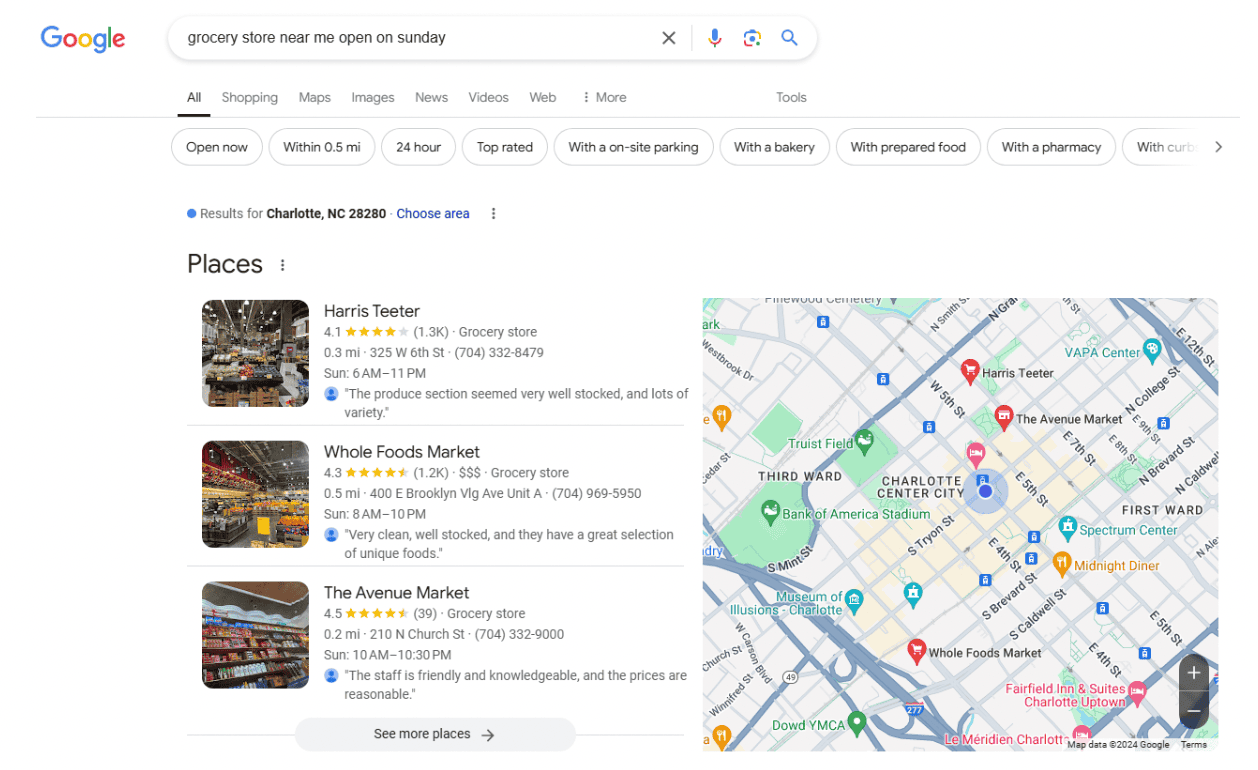
In 2026, Google records 1,5 billion "near me" searches per month, as many 'occasions to win or lose a client on the qualité of a local data.
4. Q&A content on local pages to provide quick answers to the user
AI engines prefer content that directly answers questions. On a local page, this can take the form of: "Does this store offer click & collect?", "Is there parking nearby?", "What services are available in store?"
These Q&A, naturally integrated into the page, make the content immediately extractable by an AI, and significantly increase the chances of being cited in a local answer.
The user experience is also improved: customers can find more easily what they're looking for, and navigation between local pages becomes smoother.
5. Customer reviews as a sign of trust
It's by relying on reviews that AI search tools assess the credibility of a point of sale. A store with recent, numerous and answered reviews is perceived as more reliable, and therefore more likely to appear in a generated response.
For a multi-site network, this requires active review management at the scale of your network: neither delegating entirely to local teams (risk of inconsistent tone), nor centralizing everything (risk of losing authenticity).
Deploy the store locator at scale across your network to generate more in-store traffic
For a network manager, the challenge is not whether a store locator can be optimized for AEO. It can. The challenge is doing it at scale across your network, consistently, without creating an unmanageable burden for field teams.
Here is what it concretely implies:
1- Centralize the data, decentralize the publishing.
The headquarters defines the structure, the basic data, the update rules. Local teams complement with what is specific to them: local events, new services, point‑of‑sale news.
It's this balance that allows combining brand consistency and digital local relevance, and offering a homogeneous user experience across all your locations.
2- Implement validation workflows
When a store changes its hours or services, the update must automatically propagate across all platforms, store locator, Google Business Profile, Apple Maps, and others. Without automation, these updates are applied partially, precisely creating the inconsistencies that AI engines penalize.
With Mobilosoft, a structured workflow is implemented to deploy changes across the'entire platforms. The system's scalability allows your digital team to create more local visibility without multiplying manual interventions.
Brands like Batopin were able to improve their local search rankings and measure a concrete increase in in‑store traffic, without additional workload for field teams.
→ Discover how we helped Batopin achieve +706% d'activations and +703% physical traffic.
3- Measure local performance
The store locator generates valuable data : which geographic areas generate the most searches? Which points of sale are under-visible in the search results? What are the most used search terms?
These insights allow d'adjusting the network strategy, and not just the digital strategy.
Come out winning in the local data battle
AI search engines do not have sentiment. They quote what' they understand, what' they can verify, what is consistent across all platforms. A brand with 300 points of sale but neglected local data will be beaten by a smaller, better-structured competitor.
What is at stake behind the store locator, it's the ability of a brand to exist where its customers are searching, at the right time, in the right format.
This sovereignty is built now, or it will be bought back more expensive tomorrow. If the answer is uncertain,talk to our experts.
Save time and gain visibility from today
Schedule a personalized demo and see how the platform optimizes every local action in your network.


Latest articles
Discover other selected articles to further explore the topic. To continue exploring the levers that really make a difference for your points of sale.