How to appear in Google's rich results
Schema.org has become essential for multi-point sales networks. By correctly structuring your local pages, you allow Google to identify your services, products, reviews, or schedules, and therefore display your establishments in highly visible enriched results. For brands that want to capture non-branded local searches, it's a strategic lever: a clear SEO architecture, optimized structured data, and a Store Locator capable of rising to key queries.

“As of January 29, 2021, data-vocabulary.org markup will no longer be eligible for Google's rich results features. To remain eligible beyond this date, you must replace data-vocabulary.org markup with schema.org markup."
Google Search Central

As of January 29, 2021, only schema.org website tagging will be eligible for Google's rich results features.
What does this mean for the SEO of your website and more particularly of your Store Locator pages?
- What is schema.org?
- What is a structured data schema?
- What does it mean if your Store Locator is not under schema.org?
- You are using the schema.org structure, how to optimize it best?
1. What is schema.org?
Schema.org is a collaborative community whose purpose is to create, manage and promote schemas of structured data on the internet, in open access. In addition to people belonging to the founding companies (Google, Microsoft, Yahoo and Yandex), it has a substantial participation from the web community at large.
2. What is a structured data schema?
A schema of structured data or markup allows ’organize the information of your web pages. This helps Google à understand the content of the page and thus to propose to users the most relevant results à their query.
More specifically, structured data are coded elements in the markup that are not visible on the web page and that allow structuring with a proper grammar (schema) the various information present on your pages. Thanks to this special “grammar” Google is able to precisely identify the type of element included in the page code. It can then propose in the Search and Maps search results the most relevant information to users based on their history, location, query,...
In addition to helping Google à provide more relevant search results, structured data also helps à make pages appear as rich results* during a query. These allow to highlight a result and thus generate more engagement and clicks to your pages.
* Rich Results
Rich results correspond to all search results that incorporate rich information (reviews, prices, hours, products, services, ...) within the search results page - SERP. We speak of a rich result as opposed to a classic result, composed of a URL, a title and a description.
1ere-position.fr
In Practice :
The integration of structured data in the markup allows search engines to better understand the content of your page and its relevance for certain types of queries.
Google uses structured data to provide information about a web page and its content to users. This information is used for two main purposes:
- Understanding the page content and classifying it : Google robots will analyze and classify the information présentes on your pages. For example, on a Store Locator page of a pharmacy you will find certain specific types of services intégrés in the page code following the “grammar” of schema.org. In the l'example below, we identify with the schema.org grammar a service, the type of service as well as the logo lié à this service.
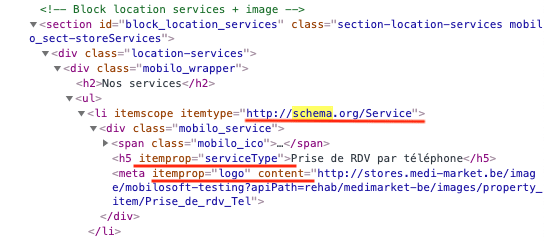
- Offer special features in search results : a page containing valid structured data is likely to appear in a search result with image, videos or via keywords or specific filters as for example “restaurant moules”.

3. What does it mean if your Store locator is not under schema.org?
If your website or your Store Locator pages do not follow the structure of schéma.org, Google will have more difficulty à judging the relevance of your Store Locator pages and they will have little chance d'apparaître on the première page of résultats Google for searches called “indirectes” covering certain types d'informations such as products, services, photos, reviews, and others...
The searches called “indirect” are searches that, for example, target a sector and a type of product, but without mentioning a brand: e.g. “Pharmacy Vitamins”
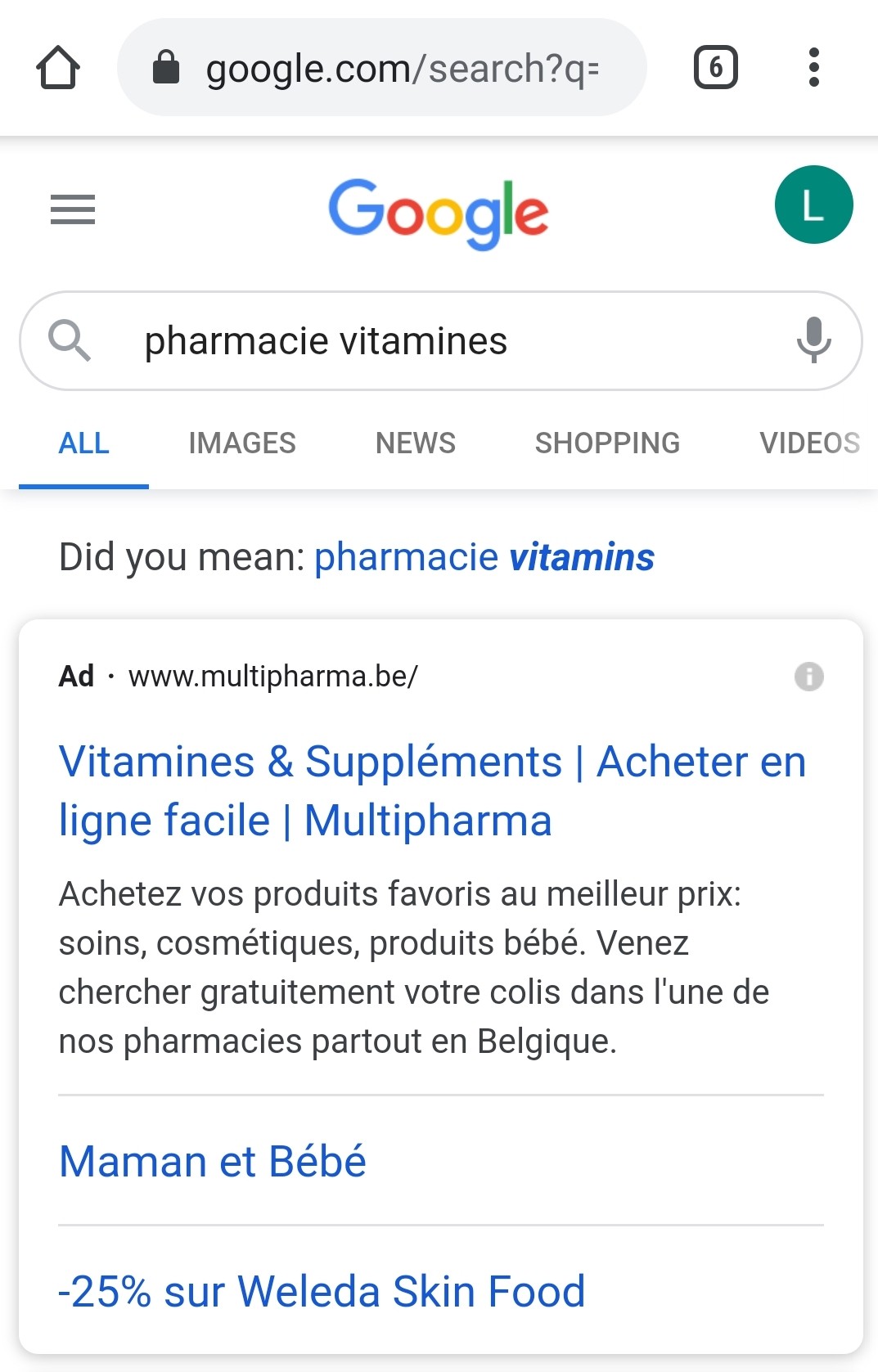
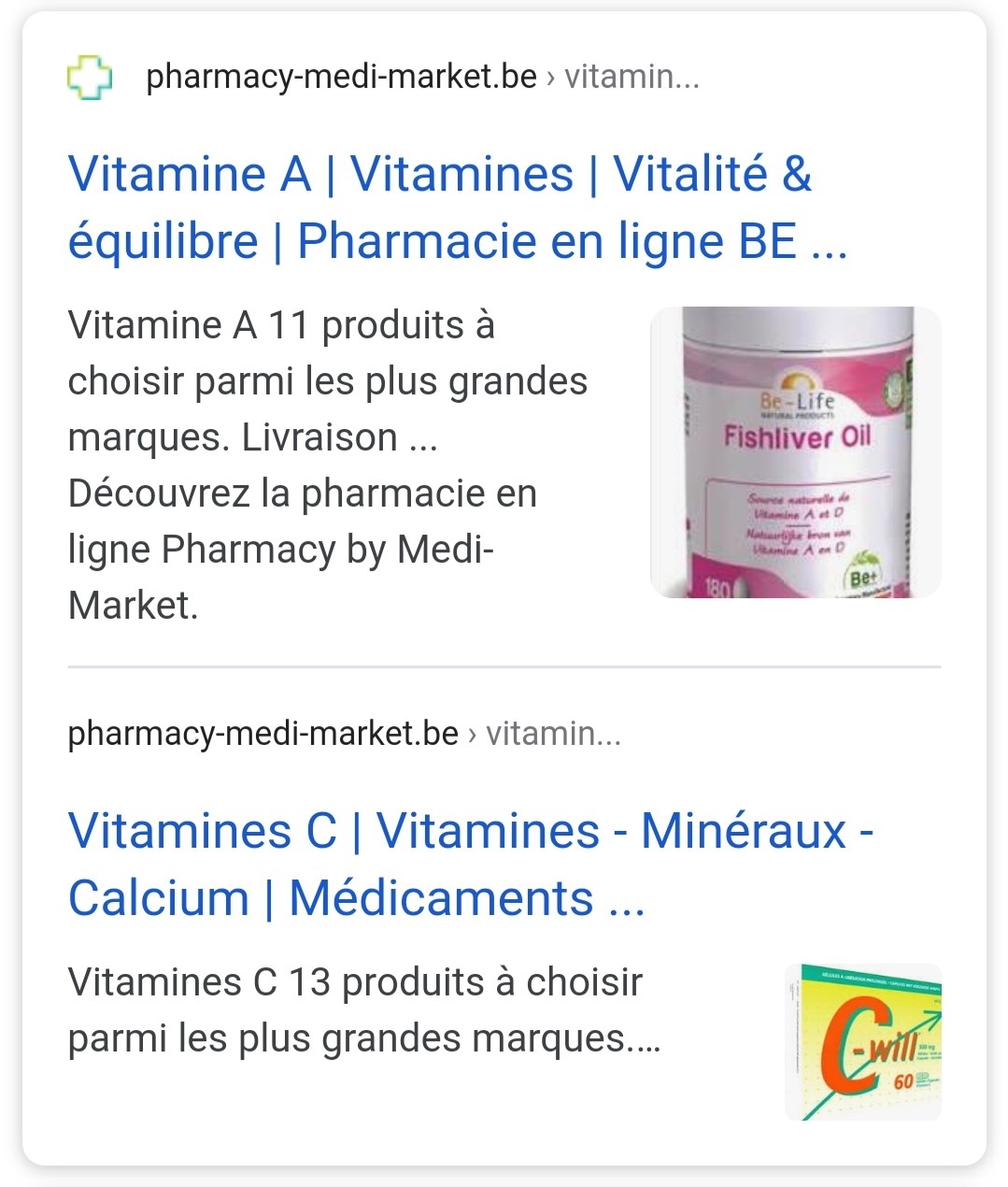
The significant advantage of optimizing the structured data tags of your Store Locator pages is that they allow your information to stand out for these indirect queries.
Appearing in the top results for this type of query is extremely interesting to stand out from the competition, especially when your brand is not top of mind for a large segment of the population.
Moreover, if the structured data tags are not under schema.org or are not applied according to Google's guidelines, your Store Locator pages will have far fewer chances of appearing in enriched search results.
This means that during an indirect search, for example “mussel restaurant”, the Store Locator page of a restaurant offering mussels will not appear as a rich result with additional information such as ratings and reviews on the results page. This enriched information provides better visibility for your page as it provides key information that users are looking for at a glance.
For example, in the case of a supermarket, Google can display opening hours like this:
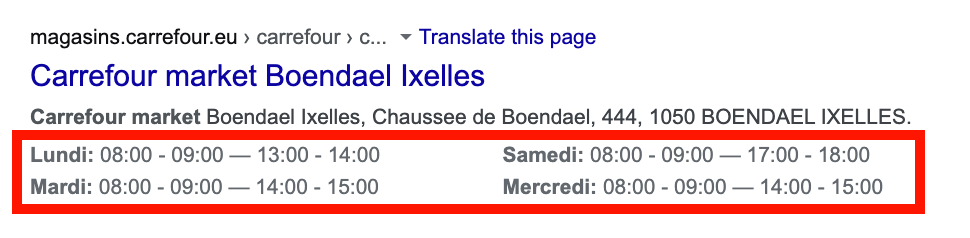
According to a study conducted by Datareportal, more than 80% of internet users specifically search for products and services online. For these products and services to be identified and appear in search results, they must be referenced with the appropriate tags when coding your web pages and store locator.
4. You are using the schema.org structure, how to optimize it best?
Schema.org offers various formats to structure all kinds of data. In the case of “local business” it also proposes, among other things, to identify:
- the opening hours
- payment methods
- the address and location
- brands associated with a product or service
- the events
- reviews
- the photos
- the services
- the products
- ….
This allows your Store Locator page to appear in indirect searches such as: "supermarket open nearby", "steak fries restaurant", …
>> Checklist: Optimize structured data tags under schema.org
Afin de ressortir dans les résultats de recherches il est important d’utiliser et compléter les balises de données structurées propres à chaque point de vente.
- Coder les balises de données structurées :
Voici la liste complète des balises proposées pour les points de vente : https://schema.org/LocalBusinessGoogle préfère le format de données structurée JSON-LD ("JavaScript Object Notation-Linked Data") car il permet de séparer en sections propre ce que les utilisateurs voient et les informations destinées au moteur de recherche. - Test structured data during development to verify that the tags of your store pages are properly optimized via the Rich Results Test
- Check the status of your pages after deployment with the Rich Results Status Reports
With Mobilosoft, manage your Facebook pages, Google Business Profile and your Store Locator in collaboration with your Store Managers & Franchises in 2 clicks.
Also allow them to invest in local Google and Facebook Ads without competing with your national campaigns.
Do you need support and advice? We are here to respond to your requests.
Check out other articles on the subject...
Save time and gain visibility from today
Schedule a personalized demo and see how the platform optimizes every local action in your network.


Latest articles
Discover other selected articles to further explore the topic. To continue exploring the levers that really make a difference for your points of sale.